
The Perseverance Rover Mars Sample Return Mission 2026 is making headlines as NASA provides updates on the mission's progress and expected outcomes. Honestly, this is wild - we're talking about a mission that could potentially change our understanding of the Mars planet and its habitability. But what does this actually mean? Let's get into the details.
What is the Perseverance Rover Mars Sample Return Mission 2026?
The Perseverance Rover is a NASA mission that launched in July 2020 and landed on Mars in February 2021. The mission's primary objective is to search for signs of past or present life on Mars and to collect samples for potential return to Earth. Look, here's the deal - this mission is a major milestone in space exploration, and its outcomes could have significant implications for our understanding of the planet and its potential for supporting life.
Image: NASA/JPL-Caltech / Wikimedia Commons (Public domain)
And the kicker?
How does the Sample Return Mission work?
The Sample Return Mission involves several steps, including sample collection, storage, and launch from Mars. The samples will be stored in a special container and launched into orbit around Mars, where they will be retrieved by a future mission and returned to Earth. But what kind of samples will be collected? According to NASA, the samples will include rocks, soil, and atmospheric gases, which will be analyzed for signs of past or present life on Mars. See also: Perseverance Rover Mars Sample Return 2026 Updates. You might also like: Perseverance Rover Methane Readings May 2026 Update.
Image: NASA/ESA/JPL-Caltech / Wikimedia Commons (Public domain)
Some of the key technologies used in the Perseverance Rover Mars Sample Return Mission 2026 include:- Sample collection and storage systems
- Launch and propulsion systems for the sample return mission
- Orbital rendezvous and sample retrieval systems
What are the potential discoveries of the Perseverance Rover Mars Sample Return Mission 2026?
The potential discoveries of the Perseverance Rover Mars Sample Return Mission 2026 are significant and could include evidence of past or present life on Mars, as well as insights into the planet's geology, climate, and habitability. According to NASA, the mission could also provide valuable information for future human missions to Mars. I know what you're thinking - what about the moon? While the moon is not the primary focus of this mission, the technologies and strategies developed for the Perseverance Rover Mars Sample Return Mission 2026 could also be applied to future lunar missions.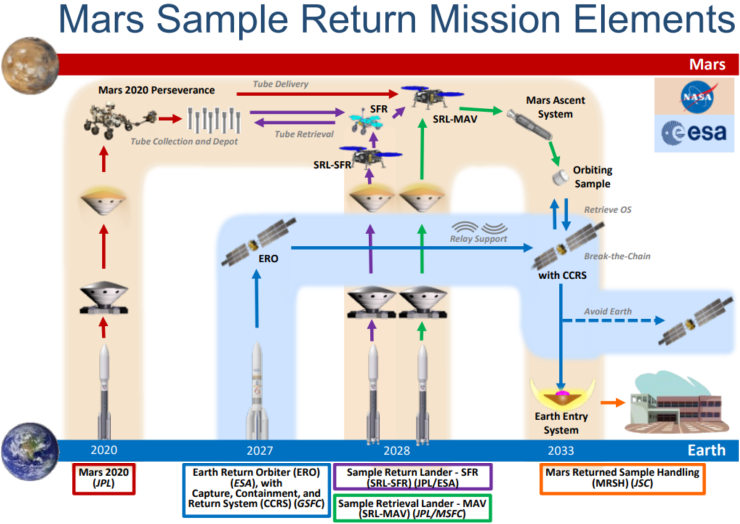 (Related: Google Bard vs ChatGPT: AI Performance Showdown)
Image: NASA/Thomas Zurbuchen / Wikimedia Commons (Public domain)
Sound familiar?